
Important: Always double check records and taxes after search. Errors are always possible on internet.
What does the Franklin County Auditor do?
The Franklin County Auditor wears more hats than most people expect. The office is best known for property values, but it is also the county’s chief fiscal officer and runs several consumer-protection programs. In practice, its work falls into four groups.
- 440,000+parcels valued countywide for the 2026 update
- 30,000+property transfers processed each year
- 35%of appraised value is what Ohio taxes (the assessed value)
- Every 3 yearsvalues are updated; a full reappraisal every 6
1. Real estate: values and records
The Auditor sets the appraised value of every parcel in Franklin County. Ohio law requires a full reappraisal every six years and an update at the three-year midpoint. The last full reappraisal was in 2023; the current cycle is the 2026 Property Value Update. Each year the appraisal staff also review parcels that changed because of a sale, new construction, a split or combination, a demolition or damage. The office keeps the official record of ownership and legal description for every parcel and processes more than 30,000 transfers a year through its Transfer & Conveyance department. Our guide to how property values are set explains the method.
2. Property tax credits, rates and distribution
The Auditor doesn’t bill or collect property taxes. It does calculate what each parcel owes. The office applies tax rates certified by the state to each parcel, applies credits and exemptions such as the Homestead Exemption and the owner occupancy credit, and hands the tax list to the Treasurer for billing. After the Treasurer collects, the Auditor’s fiscal staff settle and distribute the money to schools, cities, townships, libraries and other taxing districts. The Auditor also sits on the county Board of Revision, which hears value complaints, and on the county Budget Commission.
3. County finances
As chief fiscal officer, the Auditor keeps the county’s books, pays the county’s bills, runs payroll services for county agencies, publishes financial reports, and holds unclaimed funds such as uncashed county checks until their owners claim them.
4. Licensing and consumer protection
The Auditor sells dog licenses and kennel licenses, issues vendor’s licenses for businesses that make taxable sales, and licenses retail cigarette dealers and junk yards. Its Weights and Measures inspectors check that commercial scales, gas pumps and checkout scanners charge customers correctly.
Official Franklin County Auditor tools at a glance
Most tasks start with one of the Auditor’s free online tools. This table matches common tasks to the official tool and to the guide on this site that explains it.
| I want to… | Official tool | Our guide |
|---|---|---|
| Look up a property by address, owner or parcel | Property Search | Property search guide |
| See parcels on a map or aerial photo | Parcel Viewer | GIS & parcel viewer |
| Check my 2026 tentative value | Know Your Home Value | 2026 value update |
| Estimate my tax or a levy’s cost | Tax Estimator and Levy Estimator | Estimator guide |
| Apply for the Homestead Exemption | Online DTE 105A application | Homestead guide |
| Challenge my value | Board of Revision | BOR guide |
| Buy or renew a dog license | Dog License portal | Dog license guide |
| Calculate the conveyance fee on a sale | Conveyance Fee Calculator | Transfers guide |
| Search unclaimed county money | Unclaimed Funds Search | Unclaimed funds guide |
| Find a form | Form Center | Forms guide |
What the Auditor doesn’t do, and which office does
Four county offices handle property, and they share a building at 373 S. High St. in downtown Columbus. Calling the right one first saves a lot of time. The single biggest mix-up: the Auditor’s Office does not send tax bills or take tax payments. The Treasurer does.
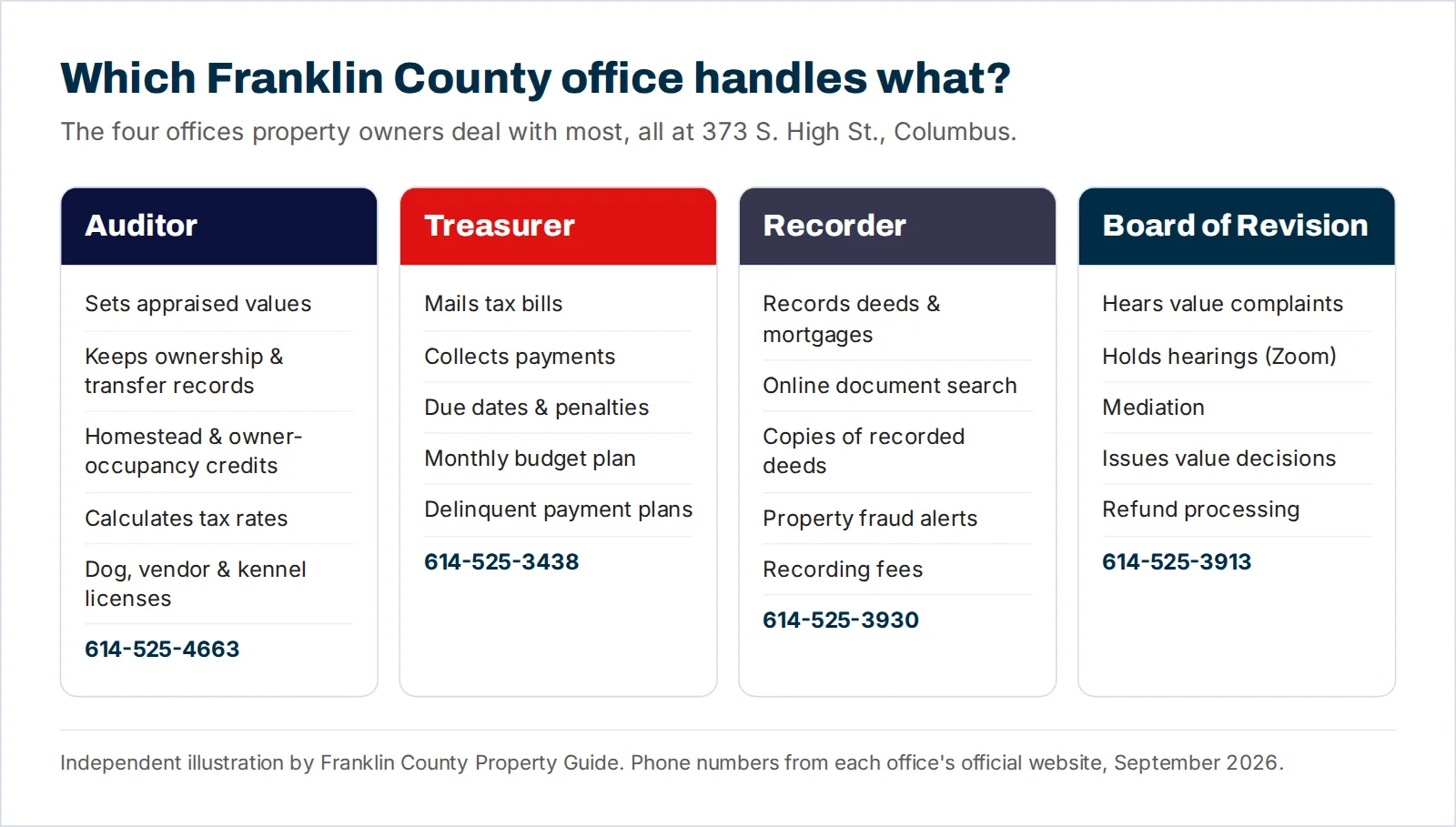
| If you need to… | Contact | Phone |
|---|---|---|
| Question a value, update building details, apply for Homestead or the owner occupancy credit | County Auditor | 614-525-4663 |
| Pay a tax bill, check due dates, set up a payment plan, change the bill’s mailing address | County Treasurer | 614-525-3438 |
| Get a copy of a deed or mortgage, record a document, sign up for fraud alerts | County Recorder | 614-525-3930 |
| File or check on a formal value complaint | Board of Revision | 614-525-3913 |
| Survey records, tax maps and county roads | County Engineer | 614-525-3030 |
| Probate a will or transfer a deceased owner’s property through an estate | Probate Court | 614-525-3894 |
Levies and tax rates are a separate matter again. Voters approve most levies, and the Ohio Department of Taxation certifies the rates each December. See Franklin County property tax rates for how that works.
Franklin County Auditor contact information and hours
Address
Franklin County Auditor’s Office
373 S. High St., 21st Floor
Columbus, OH 43215
Phone and email
614-525-4663 (614-525-HOME)
Email through the Auditor’s online contact form
Hours
Office: Monday–Friday, 8 a.m.–5 p.m. Several public counters close earlier. Hours may vary on county holidays.
Different departments sit on different floors of the same building and keep different counter hours. For example, the Transfer & Conveyance and Homestead counter on the 19th floor closes from noon to 1 p.m. Our Auditor office contacts page lists every department’s phone number, floor and hours.
Looking up a property
The Auditor’s free property search is the starting point for almost every property question in Franklin County. You can search by address, owner name, parcel ID, subdivision or map, and every record shows ownership, values, building details, sales, taxes, photos and a parcel map.
- By address: the Franklin County property search guide covers every search mode and what each tab means.
- By owner: the owner name search guide explains name formats, wildcards, LLCs and trusts.
- By parcel number: the parcel number guide decodes the 3-6-2 digit format.
- Sales and deeds: the property transfers guide shows how to research who bought what, for how much.
- Maps and boundaries: the GIS guide and the property lines guide cover the Parcel Viewer, plats and surveys.
Property values and the 2026 update
Franklin County is in the middle of its 2026 Property Value Update, the triennial midpoint between the 2023 reappraisal and the next full reappraisal. Unlike 2023, the update is a data review of arm’s-length sales from 2023 through 2025 rather than an exterior inspection of every parcel.
Tentative values went online on June 9, 2026. The Auditor’s preliminary figures showed an average increase of about 10% for residential property, about 4% for commercial and about 13% for industrial, with residential averages ranging roughly 5% to 15% by school district. For comparison, the 2023 reappraisal raised median residential values by 41%. Owners could request informal Property Value Reviews over the summer. Values then go to the Ohio Department of Taxation, and final values are expected in December 2026.
If you still disagree once final values are set, you can file a formal complaint with the Board of Revision through March 31, 2027. Read the 2026 value update guide for dates and the Board of Revision guide for how to appeal.
Property taxes: where the Auditor fits in
Your real estate tax bill starts with the Auditor’s appraised value. Ohio taxes 35% of that value (the assessed value). That figure is multiplied by your taxing district’s effective rate, credits are subtracted, and special assessments are added. The Treasurer then bills the total in two halves.
For taxes paid in 2026, the Treasurer moved the due dates to February 28 for the first half and July 20 for the second half. A 5% penalty applies if you pay the full balance within ten days after a due date, and 10% after that, plus interest on delinquent taxes.
State law changed in March 2026. House Bill 186 gradually replaces the 10% “nonbusiness” credit on homes with a larger owner occupancy credit, so owner-occupied homes gain while rentals lose the credit by tax year 2029. It also created an Inflation Cap Credit in school districts at the “20-mill floor,” though only a few districts reaching into Franklin County are at that floor. Our property tax guide explains all of this, and the tax bill guide covers paying.
Ways to lower a Franklin County property tax bill
Several programs run through the Auditor’s Office can reduce what you owe. Most require an application, so they don’t appear automatically.
| Program | Who it helps | Key facts |
|---|---|---|
| Homestead Exemption | Homeowners 65+, permanently and totally disabled homeowners, qualifying surviving spouses | Exempts the first $29,000 of appraised value; income limit $41,000 (2025 income) for 2026 applications |
| Enhanced Homestead | 100% disabled veterans; surviving spouses of public service officers killed in the line of duty | Exempts the first $58,000; no income limit |
| Owner occupancy credit | Anyone who owns and lives in their home on January 1 | 2.5% credit rising to 5.70% in tax year 2026 and 15.38% by 2029 under HB 186 |
| CAUV | Commercial farmland (10+ acres, or $2,500 average gross income) | Values land on farm use; apply before the first Monday in March |
| Board of Revision complaint | Anyone who believes the value is too high | Tax year 2026 complaints accepted through March 31, 2027 |
| Damaged property (DTE 26) | Owners whose buildings were damaged or destroyed | Value reduction for the damage; file with the Auditor |
The property tax relief guide compares all of them side by side.
Other Auditor services
Dog licenses
Due by January 31 each year. A one-year license costs $18 for a spayed or neutered dog and $35 otherwise; late fees apply after the deadline. Dog license guide.
Forms
DTE forms for exemptions, credits, conveyances and complaints, plus licensing forms. Auditor forms guide.
Unclaimed funds
Uncashed county checks and refunds. The county holds them for five years under Ohio law. Unclaimed funds guide.
Forfeited land sale
Tax-forfeited parcels sold at auction in November 2026. Forfeited land sale guide.
Franklin County property by the numbers
A few figures help put the Franklin County Auditor’s work in perspective. Each comes from an official county source and is repeated in the relevant guide.
| Figure | What it means | Where to learn more |
|---|---|---|
| 440,000+ parcels | Every one gets a new value in the 2026 Property Value Update | 2026 value update |
| 30,000+ transfers a year | Processed by the Auditor’s Transfer & Conveyance department | Property transfers |
| 35% | Share of appraised value that Ohio taxes (the assessed value) | Property taxes |
| +41% (2023) and ~+10% (2026) | Median residential change in the 2023 reappraisal; average preliminary residential change in the 2026 update | Property values |
| $3 per $1,000 | Standard conveyance fee on a sale ($1 state plus $2 county) | Property transfers |
| $29,000 / $58,000 | Value exempted by the standard and enhanced Homestead Exemption | Homestead Exemption |
| 17 townships | Unincorporated areas mapped by the County Engineer, alongside the cities and villages | GIS & maps |
A year with the Franklin County Auditor: month by month
Most of the Auditor’s deadlines repeat every year. This calendar shows what happens when, so you can plan ahead. Dates that change year to year, such as tax due dates, are shown for 2026 and should be confirmed each year.
| Month | What happens |
|---|---|
| January | January 1 is the date values and eligibility are fixed for the tax year, so you must own and live in your home on January 1 to claim Homestead or the owner occupancy credit for that year. The Auditor mails continuing Homestead applications during January. The CAUV filing window opens. Dog licenses are due by January 31. |
| February | First-half real estate taxes are due to the Treasurer (February 28 in 2026). |
| March | CAUV initial applications and renewals are due before the first Monday in March. Board of Revision complaints for the prior tax year are due March 31. |
| June | In reappraisal and update years, tentative values are released (June 9 in 2026). |
| July–September | Second-half taxes are due (July 20 in 2026). In update years, owners can request informal Property Value Reviews over the summer. |
| November | General election, often with school, city, township and library levies (November 3 in 2026). Use the Levy Estimator before you vote. |
| December | Dog licenses for the next year go on sale December 1. The state sends new tax rates to the Auditor in mid-December. Final values arrive in update years. Homestead and owner occupancy applications for the year are due December 31. |
For the specific 2026–2027 dates, see the key dates panel below or the tax bill guide.
Where to start for common situations
Most people reach the Franklin County Auditor with a specific problem. Here’s the first step for the situations we see most often.
| Situation | First step |
|---|---|
| “My property value jumped.” | Check your record’s building details for errors, then compare with your school district’s average in the 2026 update guide. |
| “My tax bill went up.” | Compare this bill with last year’s: new levies, lost credits, a value change or a new special assessment. See how taxes are calculated. |
| “I just bought a home.” | Apply for the owner occupancy credit (DTE 105C) by December 31 of the year after you move in, and confirm where tax bills are mailed. |
| “I’m turning 65.” | Check the Homestead Exemption income limit and apply by December 31. |
| “A family member died.” | Find their parcels with the owner search, check how the deed was held, and search unclaimed funds. |
| “I got a Board of Revision letter I didn’t expect.” | A school district or prior owner filed a complaint. Read the BOR guide; you aren’t required to attend. |
| “I need my parcel number.” | Search your address, or see the parcel number guide. |
| “Where exactly is my property line?” | Start with the Parcel Viewer, then a licensed surveyor. See property lines. |
| “I found a dog with a tag.” | Use the Auditor’s dog license search. See the dog license guide. |
Mistakes that cost Franklin County owners money
None of these are complicated, but each one is common, and each can cost real money.
- Not applying for the owner occupancy credit after buying. It doesn’t transfer from the seller, and under House Bill 186 it’s getting more valuable every year through 2029.
- Assuming Homestead moves with you. It doesn’t. Seniors and disabled owners who move must reapply at the new home.
- Missing December 31. Homestead and owner occupancy applications for a tax year must be filed by December 31 of that year.
- Never checking the record. A wrong square footage or an extra bathroom on your record can inflate your value for years. Checking takes five minutes in the property search.
- Missing March 31 in an update year. Tax year 2026 starts a new three-year period, so a Board of Revision complaint filed by March 31, 2027 may be your one chance until the next update.
- Paying for free services. Property records, Homestead applications and county unclaimed funds claims are free through official channels.
- Letting the dog license lapse. After January 31, an $18 one-year license costs $36.
- Not updating where bills go. Ohio law requires tax bill mailing address changes to be given to the Treasurer, and a missed bill doesn’t stop penalties.
Key dates for Franklin County property owners, 2026–2027
- 21Oct 2026
Homestead Exemption application clinic listed on the Auditor’s events calendar. Homestead guide
- 2 or 5Nov 2026
Forfeited property sale. The Auditor’s pages list two different dates; confirm before you go. Details
- 3Nov 2026
General election. Local levies appear on the ballot; the Auditor’s office is also up for election. Estimate a levy
- Dec2026
Final 2026 property values expected after state review. Value update
- 31Dec 2026
Last day to file Homestead (DTE 105A) and owner occupancy (DTE 105C) applications for tax year 2026.
- 31Jan 2027
Dog license deadline for 2027; the fee goes up after this date. Dog licenses
- 31Mar 2027
Last day to file a Board of Revision complaint for tax year 2026. BOR guide
Who is the Franklin County Auditor?
The Franklin County Auditor is Michael Stinziano. County auditors in Ohio are elected countywide to four-year terms. The Franklin County Auditor’s office is on the ballot in the November 3, 2026 general election, and Stinziano, the incumbent, ran in the May 5, 2026 Democratic primary. For the official candidate list, check the Franklin County Board of Elections.
The Auditor doesn’t act alone on values or budgets. By law, the county Board of Revision is made up of the County Treasurer, the County Auditor and a member of the Board of County Commissioners. The county Budget Commission, which reviews local budgets and tax levies, is made up of the Auditor, the Treasurer and the Prosecuting Attorney.
How the Franklin County Auditor’s Office is organized
The Auditor’s own website groups its work into four areas. Knowing which one handles your question points you to the right page and counter.
| Area | What it covers | Guides on this site |
|---|---|---|
| Auditor | The office itself: hours, contact, GIS, the Form Center, public records, community relations and legislative advocacy | Contacts, GIS, Forms |
| Consumer | Dog licensing, kennel, vendor’s, cigarette dealer and junk yard licenses, and Weights and Measures | Dog license |
| Real Estate | Property search, appraisal and the 2026 update, CAUV, damaged property, tax incentives, manufactured homes, Board of Revision, mediation, transfers, rental registration, tax rates, Homestead and the owner occupied credit | Property search, Values, BOR, Relief |
| Fiscal | Financial reporting, county finances, unclaimed funds, financial services, the Budget Commission and estate tax filing | Unclaimed funds |
Property just across the county line?
Franklin County borders Delaware, Licking, Fairfield, Pickaway, Madison and Union counties, and several Columbus-area cities cross those lines. If a property you’re researching isn’t in the Franklin County Auditor’s records, the neighboring county’s auditor holds it. Each Ohio county auditor runs its own property search, tax credits and dog licensing, so the rules on this site describe Franklin County’s procedures and deadlines specifically.
The Auditor’s role in property tax policy
Beyond administering the system, the Franklin County Auditor’s website has a Legislative Advocacy page, and its news archive includes coverage of Ohio county auditors proposing property tax relief options to state lawmakers in 2025. State law, not the Auditor, sets the rules; the Auditor applies them. The office also offers an “Ask the Auditor” page for questions from the public.
Auditor, assessor or appraiser? Ohio terms explained
If you’ve moved from another state, you may be searching for the “Franklin County assessor” or “property appraiser.” In Ohio, those jobs belong to the County Auditor.
| Term you may know | Where it’s used | Franklin County, Ohio equivalent |
|---|---|---|
| County assessor, tax assessor | Many states | County Auditor (appraisal division) |
| Property appraiser | Florida and others | County Auditor |
| Appraisal district | Texas | County Auditor |
| Property Valuation Administrator (PVA) | Kentucky | County Auditor |
| Tax collector | Many states | County Treasurer |
| Assessment appeal board | Many states | County Board of Revision |
Also note that Ohio’s Auditor of State is a different, statewide office that audits government agencies. It doesn’t handle Franklin County property records.
That’s why searches for a Franklin County assessor Ohio, a Franklin County OH property appraiser, a Franklin County tax auditor or even a “Columbus Ohio auditor” for a home’s value all lead to the same office: the Franklin County Auditor, which values property in the Franklin County part of Columbus and in every other community in the county.
All Services
- Property searchSearch by address, owner or parcel ID
- Search by owner nameFind who owns a property
- Parcel number lookupFind and read a parcel ID
- Property transfersSales, deeds and conveyance fees
- GIS & parcel viewerMaps, aerials and GIS data
- Property linesBoundaries, plats and surveys
- Property valuesHow appraised values are set
- 2026 value updateTentative and final values
- Board of RevisionAppeal your property value
- Property taxesHow your bill is calculated
- Tax bill lookupDue dates, penalties and payments
- Tax ratesEffective vs. full rates by district
- Tax & levy estimatorsEstimate taxes and ballot levies
- Tax relief programsEvery way to lower your bill
- Homestead ExemptionSeniors, disabled owners, veterans
- Owner occupancy creditThe credit for living in your home
- CAUVFarmland valuation program
- Dog licenseFees, deadlines and where to buy
- Auditor formsEvery DTE and licensing form explained
- Unclaimed fundsSearch and claim county money
- Forfeited land saleHow the auction works
- Office contactsPhones, floors and hours
Franklin County Auditor: frequently asked questions
What does the Franklin County Auditor do?
The Auditor appraises every parcel in Franklin County, keeps ownership and transfer records, applies property tax credits and exemptions, calculates and distributes property taxes, serves as the county’s chief fiscal officer, and runs licensing and consumer-protection programs such as dog licenses and weights and measures inspections.
What is the Franklin County Auditor’s phone number?
The main number is 614-525-4663, also written 614-525-HOME. Some departments have direct lines, such as Homestead (614-525-3240) and Transfer & Conveyance (614-525-3253).
Where is the Franklin County Auditor’s office?
373 S. High St., 21st Floor, Columbus, OH 43215. Some counters are on other floors of the same building, including the 19th floor for Transfer & Conveyance and Homestead.
What is the official Franklin County Auditor website?
The official site is auditor.franklincountyohio.gov. The property search runs at property.franklincountyauditor.com. Franklin County Auditor, Ohio (Property search, values, the 2026 update, taxes, Homestead and office contacts.
Is the Franklin County Auditor the same as the tax assessor?
Yes, in effect. Ohio has no county assessor. The County Auditor appraises property for tax purposes, which is the job an assessor or property appraiser does in other states.
Does the Franklin County Auditor collect property taxes?
No. The Auditor calculates what each parcel owes, but the Franklin County Treasurer sends the bills and collects payments. Call the Treasurer at 614-525-3438 for billing and payment questions.
Who is the Franklin County Auditor?
Michael Stinziano is the Franklin County Auditor. The office is on the November 3, 2026 general election ballot; the Franklin County Board of Elections publishes the official candidate list.
What are the Franklin County Auditor’s hours?
The office is open Monday through Friday, 8 a.m. to 5 p.m. Several public counters close at 4 p.m., and the Transfer & Conveyance and Homestead counter closes from noon to 1 p.m. Hours may vary on county holidays.
How do I search property records in Franklin County, Ohio?
Use the Auditor’s free property search at property.franklincountyauditor.com. You can search by address, owner name, parcel ID, subdivision or map. Our property search guide explains each option.
Related:
Sources
Facts on this page were checked against these official sources on September 26, 2026:
- Franklin County Auditor – Home page (services, events, contact details)
- Franklin County Auditor – Office and public counter hours
- Franklin County Auditor – Online Tools
- Franklin County Auditor – Appraisal (reappraisal cycle, 35% assessment)
- Franklin County Auditor – Tentative property values now available (June 9, 2026)
- Franklin County Auditor – Homestead
- Franklin County Auditor – Transfer and Conveyance
- Franklin County Treasurer – Collection dates
- Ohio Revised Code 5715.02 – County board of revision membership
- Ohio Revised Code 5705.27 – County budget commission
- Ballotpedia – Municipal elections in Franklin County, Ohio (2026)
Last updated September 26, 2026. Found an error? Report it here — see our editorial policy for how we check facts.